
Does Cannabis Help With Weight Loss
THC often raises appetite, the BMI studies are associations, and the useful work is dose, timing, and the food in the room.
Auntie Eida ·
TL;DR
Cannabis is not a weight-loss treatment, and THC commonly increases hunger. Some survey studies have linked cannabis use with lower obesity rates on average, and THCV has been studied in small metabolic trials, but that is not a diet protocol. If you already consume, eat first, read the milligrams, change one product variable at a time, and tell your clinician what you use.
Cannabis is not a weight-loss drug, and THC is more likely to sharpen appetite than shut it down. Some surveys have found that people who use cannabis are, on average, less often classified as obese, and THCV has been poked at in small metabolic studies, but none of that is a protocol you can buy in a gummy. If you already consume and you want your weight to move on purpose, match the cannabinoid, the dose, the hour, and the food within reach, then tell the clinician who already knows your meds.
Why does THC make you hungrier?
THC activates CB1 receptors involved in hunger, food reward, and how intense food smells and tastes. The familiar result is the munchies: a real rise in drive to eat, often aimed at salt, sugar, and fat. That is pharmacology, not a failure of willpower. The same endocannabinoid system that helps the body defend energy stores is the system a typical THC product occupies.

The National Institute on Drug Abuse lists increased appetite among the acute effects of cannabis. You did not fail a character test. You took a compound that pokes the same system your body uses to make sure you do not skip dinner.
Route and timing change when that hunger shows up. Inhaled THC tends to come on faster. Edibles take longer to peak and can last well into the hours when you are already on the couch, which is why the hungry window so often lands after the kitchen has gone quiet and the pantry is the nearest entertainment. Either route, the usual mistake is the same. You consume on an empty stomach with an open snack cupboard.
THC can make food more interesting. Your job is to decide which food is in the room.
This week, eat a meal with protein and fiber before you consume. Eggs, leftover salmon, lentils, yogurt, a plate of roast vegetables. Then move the chips out of the room you will sit in. Put fruit, cut vegetables, or a yogurt you already like on the table so the first thing your hands find is something you chose before the CB1 receptors had a vote.
If you buy edibles, count them as food. Chocolate and sugar still have calories when they also contain THC. A square that is also a dose is still a square. Drink water in the same window. Alcohol adds calories and makes the next decision sloppier, which is a poor pairing if the scale is already on your list.
The same appetite effect is the point if you are trying to eat more after illness, during recovery, or when nausea has been the problem. Name the goal before you shop. A hunger-promoting product helps one job and gets in the way of the other.
Timing matters as much as the compound. A session right after a balanced meal is a different experiment than a session that starts when you have not eaten since lunch. The receptors do not know your intentions. They respond to the ligand. If you want less unplanned eating, do not ask those receptors to work while the fridge is the only plan.
Keep the environment boring on purpose. Put the remote next to a water bottle. Leave a cut apple where a bag of chips used to live. If you vape, do it after dishes are done so you are not standing in the kitchen with an open fridge and a newly interesting sense of smell. Furniture decisions matter here, because CB1 does not care about your intentions.
People also confuse “I got hungry” with “I gained fat because of cannabis.” Hunger hits in the hour. Weight is a longer ledger of energy in and energy out, sleep, medication, alcohol, and what was already on the plate. Treating the munchies as a character flaw skips the pharmacology. Treating a gummy as a fat-loss plan skips the same pharmacology in the other direction.
If you share a household, say the plan out loud before anyone is high. “Dinner first, then the couch, fruit on the table” is easier to keep than a vague intention to be good. If you live alone, the same script still helps. Write it on a note on the fridge. The point is to make the next action obvious while you can still choose it.
Have studies found that cannabis users weigh less?
Some large surveys have reported that association, which is not the same as cannabis causing fat loss. Keep both facts in the same pocket. Other observational analyses have not always agreed, so the picture is not a single clean line.
In 2011, Yann Le Strat and Bernard Le Foll, writing in the American Journal of Epidemiology, examined two U.S. national surveys and found cannabis use associated with a lower likelihood of obesity. In 2013, Elizabeth Penner, Hannah Buettner, and Murray Mittleman reported in The American Journal of Medicine that current cannabis use in a large national health survey (NHANES) was associated with lower fasting insulin and smaller waist circumference.
Those papers are worth pulling if you work in this industry or you like primary sources. They are observational: users and non-users differ in age, tobacco, alcohol, diet, and activity. People with certain illnesses may use more. People who use more may skip meals, then overeat, then show a confusing average on a chart. A survey cannot tell you what would happen if you, personally, added a nightly gummy and changed nothing else.
Later discussions of this literature have repeatedly stressed the same limit. Association is not a prescription. Cross-sectional snapshots cannot separate whether cannabis changed body weight, whether people with lower body weight were more likely to use, or whether unmeasured habits did the work. Heavy use, occasional use, and former use are not the same exposure, and surveys often collapse them. If you sell or formulate, that limit belongs in the brief you give copywriters.
The U.S. Food and Drug Administration has not approved marijuana, THC, CBD, or THCV to treat obesity or to promote weight loss. If a menu, a budtender script, or a landing page suggests a cultivar is for cutting weight, that claim is ahead of the evidence and ahead of the label.
If you formulate or sell, keep weight-loss language off the pack unless you have a drug approval you do not have. A certificate of analysis that lists cannabinoids is useful; copy that promises a smaller waist is still copy. For everyone else, read the milligrams and the ratio. Ignore the lifestyle headline on the tin.
There is also a practical reading of the survey papers that does not require a miracle cultivar. If some users eat more in the evening and still show lower average obesity in a dataset, something else in their lives may be doing work the plant is being credited for. You cannot buy that “something else” in a jar. You can still eat dinner first, keep alcohol off the pairing, and stop treating a COA like a diet plan.
Do not turn those two papers into a before-and-after story for your own body. They did not randomize you. They did not control your pantry. They did not follow what happened when a high-THC edible landed on an empty stomach at 10 p.m. Use them as a reminder that the science is interesting and incomplete, then go back to the milligrams you can actually name.
Do CBD and THCV change appetite the way THC does?
CBD does not usually throw the same CB1 hunger switch, so you should not expect the same acute surge you get from THC. That difference in acute effect still does not mean CBD reduces body fat. Human trials have not established CBD as a weight-loss agent, and a nightly oil will not correct the munchies you still get if the product also contains enough THC to matter.

Read the ratio. A CBD gummy with a meaningful amount of THC is a THC product with CBD in it. Start from the milligrams on the lab panel, not the front of the tin. Full-spectrum oils can carry enough THC, at a high enough serving, to change appetite even when the brand story is all CBD.
THCV, tetrahydrocannabivarin, shows up in some southern African landrace-descended cultivars and in a small number of formulated oils and vapes. Preclinical work has explored THCV as something that does not behave like THC on appetite, with effects that can depend on dose. A 2016 randomized study in Diabetes Care, led by Khalid Jadoon and colleagues, tested delta-9-THCV and CBD in adults with type 2 diabetes and reported mixed metabolic findings that the authors treated as preliminary. That paper is a starting point for a literature search, not a reason to empty a cart.
If you want to try a THCV-forward product this week, do it as a single-variable test. Confirm THCV on the lab report, keep THC modest, keep your meals the same, and write down hunger for a few days. Flower on many U.S. retail menus is bred primarily for THC. Trace THCV next to high-THC flower is unlikely to run the show.
Ask for the number. Then still hedge. A terpene story, or a landrace name on a menu board, will not stand in for a metabolic plan. If the COA does not list THCV at a level you can actually dose, you are smoking or eating whatever else is in the product and calling it a THCV experiment.
CBD products also vary in whether they are isolate, broad-spectrum, or full-spectrum, and in how much THC they may carry at a given serving. If appetite is the variable you care about, the milligrams of THC are the first number, not the brand’s wellness vocabulary. If the panel is missing, you do not have a product you can reason about. If the panel exists and THC is not trivial at your serving size, treat the product as a THC product, whatever the front of the tin says.
Do not stack a new minor cannabinoid on top of a new diet and a new gym schedule and then decide the plant “worked.” You will not know which lever moved. Change one thing, take a few days of notes on the same meals, and you have a test. Change four things and you have a story you will tell yourself.
How do hormones, sleep, and stress change the picture?
Hunger is not only a cannabis story. In the luteal phase after ovulation, progesterone rises and many women already want more food and more carbohydrate. Pair that week with an evening edible and you are stacking two appetite signals. If you track a cycle, put your higher-THC nights on days you already eat well and sleep enough, not on the days you are already ravenous and exhausted.

Perimenopause can scramble sleep and shift fat toward the midsection. Cannabis is a common homemade sleep aid. The evidence that it improves sleep in a durable, nightly way is mixed, and a groggy morning can erase the walk, the gym, or the decent breakfast. If insomnia is the driver, say so to a clinician. Weight is downstream of sleep for a lot of women in their 40s and 50s. Treat the driver.
PCOS already means insulin and appetite are on the table. If you take metformin, spironolactone, or a GLP-1 receptor agonist, cannabis is still an extra variable with a thin interaction literature. Disclose it. A prescriber cannot help you with a product they do not know you use.
The American College of Obstetricians and Gynecologists advises against cannabis during pregnancy. Do not treat it as a weight-management tool in pregnancy or while nursing. If weight is the concern in those months, the conversation belongs with obstetric care, not a dispensary.
Stress eating and THC-enhanced food reward can travel together. If you consume to take the edge off after work, build a short buffer: water, a shower, a plate of the dinner you meant to eat, then cannabis. The buffer is boring. It is also more under your control than a new cultivar pitch.
If you are older and you use cannabis for pain or sleep, name the dose in milligrams and wait before you take a second serving. Edibles are easy to restack. Restacking is how the next day’s grogginess, balance, and appetite all get away from you, especially if you already take blood pressure, diabetes, or sleep medication.
None of this is a claim that cannabis treats hormonal conditions, PCOS, or menopause. Those conditions have medical options, and cannabis is just an extra input. The useful move is to stop treating it as invisible when you talk to the person who already manages the rest of the list.
Sleep loss itself raises hunger and makes high-calorie food more appealing, with or without a plant. If cannabis helps you fall asleep some nights and leaves you foggy other mornings, you have a tradeoff, not a weight tool. Write down which nights were which before you decide the plant is the reason the scale moved.
Medication changes belong in the same notebook. A new GLP-1, a steroid burst, a shift in thyroid dose, or a week of poor sleep will move appetite harder than a 2.5 milligram difference on a gummy. If you do not write the other variables down, you will blame the wrong one.
What should you do this week if you use cannabis and you care about weight?
Choose one window. Evening is fine. All-day grazing on low-dose sips is how dose and snacks both drift.
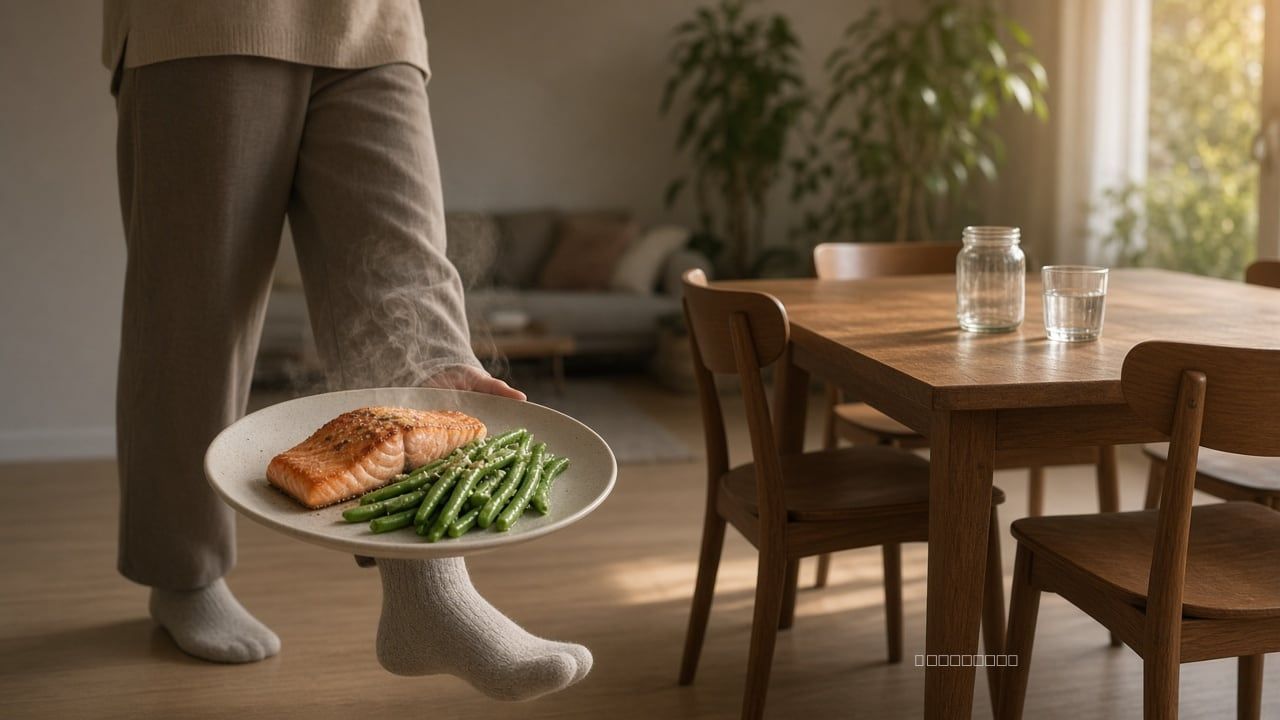
Eat first. Protein and plants on the plate, then your flower, vape, or gummy. Keep water in the same room. Keep a planned snack in the same room. Keep the delivery app logged out if that is your particular trap. Walk after dinner before you consume, or put the shoes where you will trip on them. THC makes the couch more persuasive. Design the room so the walk happens first.
Write three lines for three nights: what you used (product, milligrams if you know them, time), how hungry you felt later, and what you ate. Bring the note if you already have a visit scheduled for blood pressure, diabetes, cholesterol, or PCOS. You are giving the person who adjusts your meds a complete picture.
Change one product variable, not four. If you usually use high-THC flower at night, a single switch to a CBD-forward tincture or a lower-THC edible is enough to learn something. A new workout, a new diet, and a new cannabinoid in the same week will teach you nothing about cannabis.
Skip any product that markets itself as a fat burner. You want a lab panel, a dose you can name, and a meal plan that still works on nights you do not consume. You do not need a new THCV vape to start. You need the groceries you already know how to cook, plus honesty about the munchies.
If you work on the industry side, the consumer version of that sentence is also the compliance version: sell what is on the COA, not a waistline. If you are the person holding the tin, the week’s work is smaller and more concrete. Dinner first. One window. Notes for three nights. A clinician who is allowed to know.
A scale lags. Hunger in the two hours after you consume leads. If that leading signal is a raid on the pantry, change the pantry and the timing before you change the strain. If hunger looks fine and the scale does not, look at sleep, medication, alcohol, and the rest of the plate, not at a new minor cannabinoid with a thin human file.
Do not expect a dispensary conversation to replace a clinical one. Budtenders can show you a COA, but they cannot interpret your metformin, your GLP-1, your blood pressure pills, or your luteal-phase hunger. That is why the last instruction is the same as the first: tell the clinician who already knows your meds.
If you do not already have a clinician in the loop, this is not a reason to start a weight experiment with a new cannabinoid. Get the medical list on the table first. Cannabis will still be there after that conversation. The munchies will too. Plan the meal, the room, and the hour as if the plant is going to do exactly what THC is known to do: make food more interesting. Then decide whether that is the job you wanted it to do.
FAQ
Can cannabis replace a GLP-1 shot or a structured diet?
No. It is not approved for weight loss, and THC often increases appetite. Keep taking prescribed medication as directed and tell your clinician what cannabis you use.
Is there a best strain for weight loss?
There is no reliable strain map for fat loss. Ask for THC, CBD, and THCV on a lab report, and treat high THC as appetite-promoting until your own notes say otherwise.
Does CBD burn fat?
There is not good human evidence that CBD alone reduces body fat. CBD also usually does not trigger munchies the way THC does, which is a different claim.
Will I gain weight if I stop using cannabis?
It depends on what you eat and how you sleep when you stop. Some people eat less without THC. Some replace it with alcohol or grazing. Watch food and sleep for the first stretch, not folklore.
What if I use cannabis for pain or sleep and I still want to lose weight?
Keep the symptom relief if it is working, eat before you consume, fix the food in the room around the dose, and tell the clinician managing the pain or insomnia what you take.
Sources
- FDA strongly advises against cannabis, CBD, or THC use during pregnancy or while breastfeeding (U.S. Food and Drug Administration)
- Cannabis (Marijuana) | National Institute on Drug Abuse
- FDA Regulation of Cannabis and Cannabis-Derived Products, Including Cannabidiol (CBD)
- The cannabinoid Δ9-tetrahydrocannabivarin (THCV) ameliorates insulin sensitivity in two mouse models of obesity